
Track & Improve
How to Track Your Golf Stats (and Actually Get Better)
Tracking golf stats produces improvement only when you record the right numbers, compare them against a meaningful benchmark, and act on what the data shows — not when you collect more of the same stats you already ignore.
Why do most golfers track stats but never improve?
Tracking statistics is only useful if the stats you capture can actually tell you what to practice. Most amateur golfers record totals — putts, fairways, greens — that hide the cause of bad scores rather than reveal it.
You can fill a season of scorecards with fairways hit, greens in regulation, and total putts and still have no idea whether your approach play or your lag putting is costing you more strokes. Counting outcomes without context is the core problem. The fix is measuring shots against a baseline so every number is in units of strokes — the only currency that decides your score.
The framework that does this is strokes gained, developed by Mark Broadie. It converts every shot — tee shot, approach, chip, putt — into a single, fair number relative to a benchmark. A coach or player who reads those numbers can immediately see which category is leaking strokes and by how much.
The benchmark matters as much as the stat
Comparing your putting to a scratch golfer when you are a 15-handicap sets an impossible standard and masks real progress. Compare to your handicap peer group first; use scratch as the long-term aspiration.
What stats are actually worth tracking?
A small set of strokes gained categories — off the tee, approach, around the green, and putting — tells you everything you need. Traditional stats are useful only as inputs to those calculations.
| Stat | What it tells you | Its blind spot |
|---|---|---|
| Strokes gained off the tee | How much your tee shots gain or lose vs. the benchmark | None — it prices both distance and accuracy in strokes |
| Strokes gained approach | Your biggest scoring lever for most handicap levels | Needs distance-to-pin at the end of the shot to be precise |
| Strokes gained around the green | Short-game effectiveness priced in strokes | Separates from putting, so you can isolate each |
| Strokes gained putting | Your putting vs. the baseline, putt by putt | High round-to-round variance — judge over many rounds |
| GIR | Ball-striking consistency as a quick habit check | Treats a 2-foot and a 50-foot putt the same |
| Fairways in regulation | Rough tendency off the tee | Ignores distance — a straight short drive still counts |
| Putts per round | A rough putting volume check | Penalises good ball-striking; meaningless without distance context |
For a deeper look at which of these to prioritise at your skill level, read the golf stats worth tracking.
How do you actually record stats on the course?
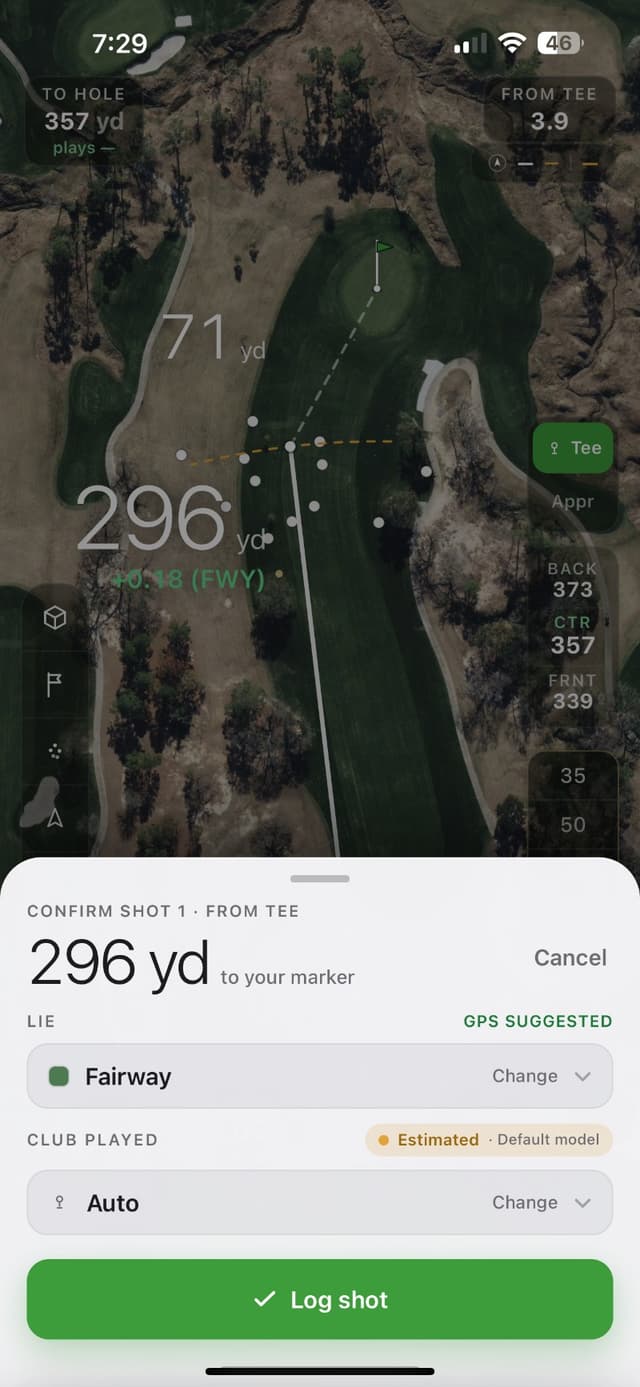
You need three things per hole: the distance each shot starts from the flag, the lie it starts from, and the lie it finishes in. Everything else the model derives.
Shot logging: shot logging is the practice of recording the starting distance, starting lie, and finishing lie of each shot so that a strokes gained calculation can be applied after the round.
- Before each shot, note the distance to the flag (GPS watch, laser, or course yardage markers) and your current lie (fairway, rough, bunker, green).
- Play the shot normally — do not change your routine.
- Note where the ball finishes: lie type and rough distance to the flag if still off the green. On the green, pace or estimate the remaining putt distance.
- Record putts individually, including the starting distance of each one.
- After the round, enter the data into PinFlag (or any strokes gained tool) to get per-category numbers.
This takes about 10 extra seconds per shot during the round. Coaches who use PinFlag for coaches can have students log on mobile and review the results together in the next lesson without any extra admin.
How do you turn your stats into improvement?
The data cycle is four steps: log, identify the biggest leak, practice that category deliberately, and re-measure. Repeat. Most golfers skip the re-measure step and therefore never confirm whether the practice worked.
Once you have strokes gained numbers across a few rounds, rank the categories by how many strokes per round you’re losing. That ranking is your practice priority list. Working on your weakest category first — not your favourite drill — is the most reliable way to lower your handicap index. See the complete method in how to build a data-driven practice plan.
| Step | Action | What success looks like |
|---|---|---|
| 1. Identify | Find the category with the worst strokes gained over 4+ rounds | One clear category stands out from the others |
| 2. Drill | Design practice specifically targeting that category | Practice time matches the size of the leak |
| 3. Re-measure | Log rounds and check whether the number is improving | Category moves measurably toward zero or positive |
| 4. Advance | Once the leak closes, find the next biggest weakness | Continuous, data-confirmed improvement |
How many rounds of data do you need before the numbers are meaningful?
Golf is high-variance. A single round can look very different from your true ability level. In practice, five to ten rounds give you a reliable read on trends; fewer is directional but not conclusive.
This is especially true for putting, which fluctuates most round to round. Approach play tends to stabilise faster because it happens on more shots per round and is less dependent on small surface variations. Coaches using PinFlag can track rolling averages across their roster so a single outlier round doesn’t distort the coaching focus.
What to do with only one or two rounds logged
Even a single round gives you a directional signal. If strokes gained approach is −3.0 in round one, it’s almost certainly worth practising regardless of sample size. Use early data to set a hypothesis; use later data to confirm it.
Frequently asked questions
What is the easiest way to start tracking golf stats?
How long does it take to track stats during a round?
Should I track stats by myself or with a coach?
Is total putts a useful stat to track?
How many rounds do I need before my stats are reliable?
Sources
Keep reading
Strokes Gained
Strokes Gained Explained: The Complete Guide
Strokes gained measures every shot against a benchmark of expected scores, revealing exactly where you gain or lose strokes versus a chosen standard — instead of guessing from fairways, greens, and putts.
Track & Improve
The Golf Stats Worth Tracking (and the Ones to Ignore)
The golf stats worth tracking are those measured in strokes relative to a benchmark — strokes gained categories — because they directly show you where you are gaining and losing shots; traditional counting stats like total putts and fairways hit hide more than they reveal.
Track & Improve
How to Build a Data-Driven Golf Practice Plan
A data-driven golf practice plan uses strokes gained numbers to identify your single biggest scoring leak, then allocates practice time in proportion to how many strokes each category costs — so you spend most of your time on the thing that will lower your score fastest.
Track & Improve
How to Lower Your Handicap With Data
The fastest way to lower your golf handicap is to identify the strokes gained category costing you the most shots per round and focus your practice there first, rather than spreading effort evenly across a game that already has some strong areas.