

Strokes Gained
Strokes Gained Explained: The Complete Guide
Strokes gained measures every shot against a benchmark of expected scores, revealing exactly where you gain or lose strokes versus a chosen standard — instead of guessing from fairways, greens, and putts.
What is strokes gained?
Strokes gained is the difference between the expected strokes to hole out before and after a shot, minus the one stroke you took. Positive means you beat the benchmark; negative means you lost ground to it.
Strokes gained: a measure of how much better or worse a shot is than a benchmark, equal to the expected strokes to hole out from where the shot started, minus the expected strokes from where it finished, minus the one stroke you took.
The benchmark is a large dataset of how many strokes it typically takes to finish a hole from a given distance and lie. Compare your result to that benchmark and you get a single, fair number — in strokes — for every shot, whether it was a 320-yard drive or a tap-in.
The method was developed by Columbia Business School professor Mark Broadie and adopted by the PGA Tour, which launched Strokes Gained: Putting in 2011 and added the tee-to-green categories in 2016. It is now the standard way tour analysts, coaches, and serious amateurs measure performance.
How is strokes gained calculated?
Strokes gained = expected strokes from the start position − expected strokes from the end position − 1. The two "expected" figures come from a baseline table; the worked example below uses putting, where the numbers are clearest.
Every starting point on a course has an expected score — the average number of strokes a benchmark golfer needs from there. Subtract the expected score where your shot finished, then subtract the stroke you spent, and you have the strokes gained for that shot.
| Distance | Expected putts to hole out |
|---|---|
| 3 ft | 1.04 |
| 5 ft | 1.23 |
| 8 ft | 1.50 |
| 10 ft | 1.61 |
| 15 ft | 1.78 |
| 20 ft | 1.87 |
| 30 ft | 1.98 |
| 40 ft | 2.06 |
| 60 ft | 2.21 |
Worked example — you face a 15-foot birdie putt and hole it:
- Find where the shot starts. From 15 feet, the tour baseline is 1.78 strokes to hole out.
- Take the shot and find where it ends. You hole the putt, so the end position — in the cup — has a baseline of 0.
- Apply the formula. Strokes gained = 1.78 − 0 − 1 = +0.78.
- Read the result. You gained 0.78 strokes on that one putt, because the average player needs nearly two putts from 15 feet.
The same putt, three outcomes
Two-putt from 15 feet: 1.78 − 0 − 2 = −0.22. Three-putt: 1.78 − 0 − 3 = −1.22. Three-putts are where amateurs quietly bleed strokes — and strokes gained makes the cost obvious.
What are the four strokes gained categories?
Every shot falls into one of four buckets: off the tee, approach, around the green, and putting. The first three add up to "tee to green"; all four add up to your total.
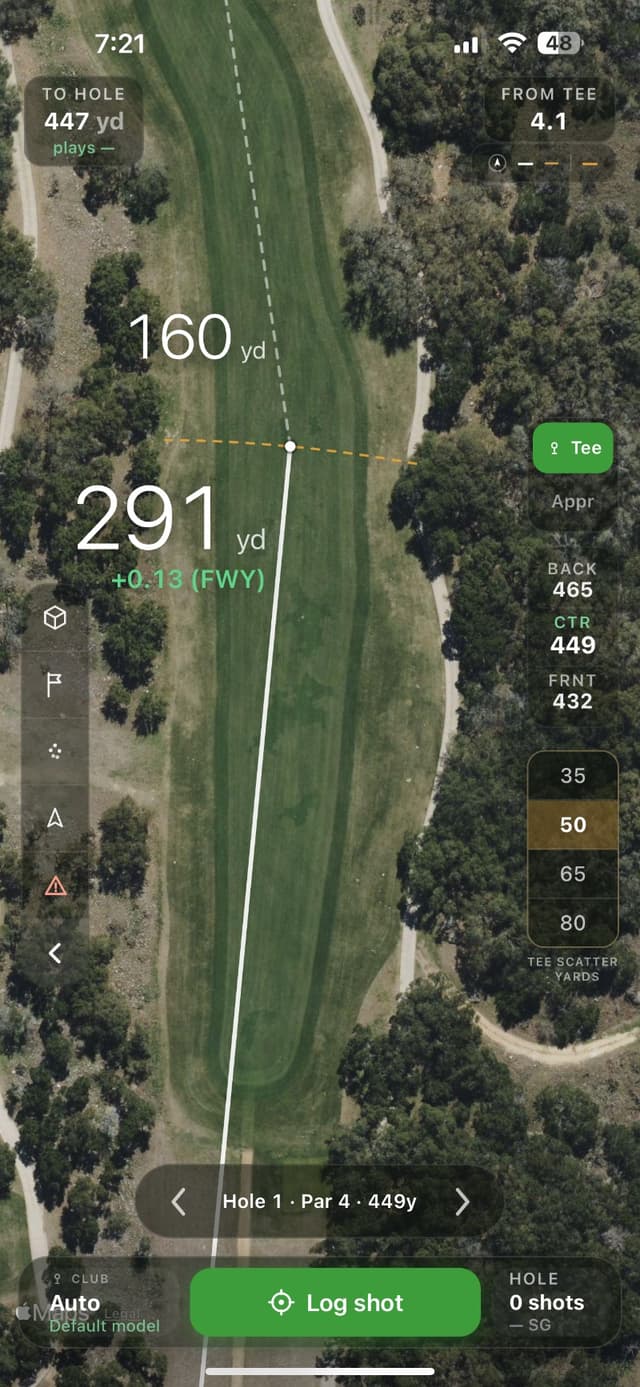
| Category | What it covers | Why it matters |
|---|---|---|
| Off the tee | Tee shots on par 4s and par 5s | Distance and accuracy that set up the rest of the hole |
| Approach | Shots to the green from beyond ~30 yards | The single biggest separator between skill levels |
| Around the green | Chips, pitches, and bunker shots within ~30 yards | Recovers — or wastes — the strokes your approach left |
| Putting | Every stroke on the green | High variance, but smaller scoring impact than most golfers assume |
Off the tee + approach + around the green make up strokes gained tee-to-green; add putting and you have total strokes gained. Splitting your game this way is what turns "I played badly" into "I lost 2.3 strokes on approach" — a problem you can actually practice. See strokes gained off the tee, approach, around the green, and putting for each one.
How do you read your strokes gained numbers?
A strokes gained number is always relative to a baseline — usually a scratch golfer or your own handicap peer group. Positive is a strength; negative is a leak. The size tells you how big.
You choose the benchmark. Measured against a scratch golfer, your numbers show the gap to elite play; measured against your handicap level, they show whether you’re ahead of or behind your peers. PinFlag lets you do both, so a 12-handicap sees where they stand against both scratch and other 12s.
| Strokes gained (one category, per round) | What it tells you |
|---|---|
| +2.0 or more | Elite — a genuine weapon versus the baseline |
| +0.5 to +2.0 | A clear strength |
| −0.5 to +0.5 | Roughly at your baseline |
| Below −0.5 | A leak — a strong candidate for your next practice block |
Broadie’s data shows that roughly two-thirds of the scoring gap between amateurs and tour pros comes from the long game — and approach play is the single biggest differentiator, not putting.
Why is strokes gained better than fairways, greens, and putts?
Traditional stats count outcomes without context, so they can hide weaknesses and even punish good play. Strokes gained prices every shot in the only currency that matters — strokes.
- Total putts punishes good ball-striking. Hit every green to 40 feet and two-putt and you "only" had 36 putts; chip close all day and you’ll have fewer putts but a worse score. Putts alone can’t tell those rounds apart.
- Greens in regulation ignores distance. A green hit to 2 feet and one hit to 50 feet both count as one GIR, yet they’re worth very different scores.
- Fairways hit ignores how far you missed. A drive in the light rough 30 yards further on is often better than a "fairway" 40 yards back.
Strokes gained fixes all three by comparing where each shot finished to a benchmark. For the full breakdown, read strokes gained vs. traditional stats.
How do you start tracking strokes gained?
You don’t need a launch monitor or GPS — only the distance and lie of each shot, which a normal scorecard already implies. Log a few rounds, let the model do the math, and act on your biggest leak.
- Log each round the way you already score it — fairways, greens, putts, and up-and-downs — on your phone.
- Let PinFlag compute strokes gained for every category against your chosen baseline. No hardware required.
- Find your single biggest leak — the category costing you the most strokes per round.
- Build one practice priority around that leak instead of spreading effort thin.
- Re-measure after a few rounds to confirm the number is moving in the right direction.
That loop — measure, find the leak, practice it, re-measure — is the heart of a data-driven practice plan. Coaches run the same loop across a whole roster with PinFlag for coaches.
Frequently asked questions
Who invented strokes gained?
Is a positive or negative strokes gained good?
Can you track strokes gained without a launch monitor or GPS?
What is a good strokes gained number for an amateur?
What is the difference between strokes gained and handicap?
Sources
Keep reading
Strokes Gained
Strokes Gained Putting, Explained
Strokes gained putting measures your putting against a benchmark by comparing the expected putts to hole out from each starting distance to the number of putts you actually take.
Strokes Gained
Strokes Gained Off the Tee, Explained
Strokes gained off the tee measures your driving by comparing the expected strokes to finish the hole from the tee with the expected strokes from wherever your tee shot finished — on par 4s and par 5s only.
Strokes Gained
Strokes Gained Approach, Explained
Strokes gained approach measures your shots into the green from beyond about 30 yards — and it is the single biggest separator between skill levels.
Strokes Gained
Strokes Gained vs. Traditional Stats (Fairways, Greens, Putts)
Strokes gained prices every shot in strokes against a benchmark, while traditional stats — fairways, greens, and putts — count outcomes without context, so they can hide weaknesses and even punish good play.
