Strokes Gained
Course Management Basics: A Numbers-First Approach
Course management is a sequence of target decisions, and each one has a strokes-gained cost that can be reasoned about with the same expected-strokes arithmetic used everywhere else in the game — tee shots, par-5 layups, and penalties included. A penalty costs exactly one stroke plus whatever position you’re left in, which is why the real cost of playing toward trouble is usually larger than the one stroke most golfers mentally budget for it.
What does numbers-first course management actually mean?
Numbers-first course management treats every target — off the tee, into a par 5, around a hazard — as a comparison between the expected strokes of the options available, rather than a single instinct about which club feels right.
For most of golf’s history, course management was taught almost entirely by feel and anecdote: play safe here, take it on there, based on a coach’s or caddie’s accumulated experience. Mark Broadie’s strokes-gained framework, published in Every Shot Counts (2014), gave that instinct a common unit — strokes — so two very different-looking decisions could finally be compared on the same scale. In the years since, a range of course-management and shot-tracking tools have built on that same expected-strokes logic, applying it to specific decisions like layup distance and target line for both tour players and serious amateurs.
None of this replaces judgment — wind, nerves, and a hundred small course conditions still matter, and no baseline table knows what a specific player is capable of on a specific day. What it replaces is guessing at the size of a decision. “Play it safe” and “go for it” are not equally vague once each option has an expected-strokes number attached to it.
How do you pick a tee-shot target?
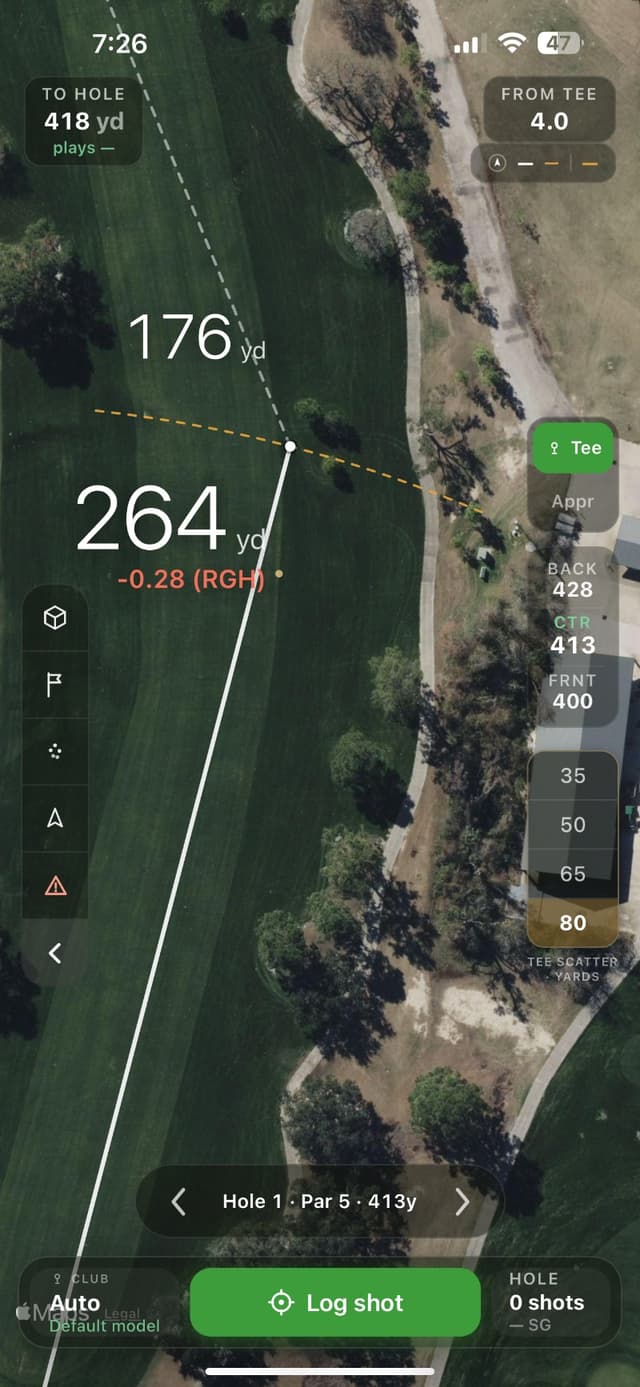
A tee shot’s value is decided by where it finishes, not by how far it traveled — so the target should be the spot on the fairway with the best realistic expected strokes for the approach that follows, not simply “as far as possible.”
| Hole | Tee baseline | Leaves | Result baseline | Strokes gained off the tee |
|---|---|---|---|---|
| 420 yd | 4.020 | 155 yd, fairway | 2.960 | 4.020 − 2.960 − 1 = +0.060 |
| 420 yd | 4.020 | 155 yd, rough | 3.210 | 4.020 − 3.210 − 1 = −0.190 |
| 380 yd | 3.960 | 100 yd, fairway | 2.800 | 3.960 − 2.800 − 1 = +0.160 |
The first two rows are essentially the same drive — same finishing distance from the green — with one difference: fairway instead of rough. That difference alone is a 0.250-stroke swing (+0.060 versus −0.190), identical to the 155-yard fairway-versus-rough gap covered in golf shot dispersion. The target that matters off the tee is the widest strip of fairway a player’s real dispersion pattern can hit reliably, not the single longest number their driver is capable of on its best swing.
The third row shows why a shorter, more conservative tee shot can still be the stronger play on a shorter hole: a 380-yard hole that leaves 100 yards from the fairway produces a bigger strokes-gained number off the tee than a longer, riskier line that finds trouble would. Distance is valuable — Broadie’s data is clear that amateurs generally underrate it — but only when the pattern around a longer target still finds playable ground often enough to cash in on the extra yardage.
How should you think about par-5 decisions?
A layup distance is itself a target with its own strokes-gained cost, and the real question on a par 5 is a comparison between two landing distributions — one that includes a chance at the green in two and one that doesn’t — not a binary “go or lay up.”
Framed as pure arithmetic, laying up is not one decision — it is at least two: how far to lay up, and whether to challenge the green at all. Even the first question has a real strokes-gained answer before the second is considered. Using the fairway distances above, leaving 135 yards (baseline 2.894) instead of 175 yards (baseline 3.054) from the same tee shot is worth 0.160 strokes (3.054 − 2.894) on its own, before any decision about going for the green enters the picture — a shorter, more precise layup number is not a timid choice, it is frequently the higher-value one.
Going for the green in two adds a second comparison: the expected strokes of the shots that find the green against the expected strokes of the shots that find the trouble guarding it, weighted by how often a real dispersion pattern produces each outcome. A player whose pattern rarely finds the water has a very different answer than a player whose pattern finds it one time in five — same hole, same pin, different number, because the pattern is different. This is the same logic covered in golf shot dispersion, applied to a single, high-stakes decision.
What does a penalty actually cost?
A penalty costs exactly one stroke plus whatever position the resulting drop leaves — and because the position part is easy to underestimate, the true cost of a penalty is usually larger than the single stroke most golfers mentally budget for it.
Penalty cost (in strokes gained): the one added stroke required by the rules, plus the strokes-gained difference between where a player ends up after the penalty and where the shot that found trouble was trying to go — not just the added stroke in isolation.
Consider a shot from 175 yards in the fairway (baseline 3.054) that finds a penalty area guarding the green. After the stroke and the drop, the player is left with essentially the same 175-yard look they started with — no progress at all. That shot is scored as 3.054 − 3.054 − 1 − 1 = −2.000: one stroke for the swing itself, and a full additional stroke for the penalty, because the position component is zero when the drop makes no net progress toward the hole.
That −2.000 figure is the clean, structural case — zero progress, isolating the penalty’s true cost. In practice the number moves in both directions: a drop that leaves a harder position than 175 yards (further back, a worse lie) makes the total loss larger, while a lateral drop that happens to leave a shorter, easier shot than the original offsets part of the one-stroke penalty and softens the total loss. The one constant is the extra stroke itself — position is the variable, but the stroke is not.
A penalty is not just “one shot”
Most golfers mentally file a penalty as “one extra shot,” but the strokes-gained arithmetic shows the real cost is that stroke plus whatever ground was lost or gained on the drop. Two penalties on the same hole rarely cost the same amount for exactly this reason.
What does playing away from trouble actually buy you?
Playing away from trouble is a bet that a small loss in average proximity is smaller than the strokes-gained cost of the tail outcome it avoids — and because penalty shots are so expensive, that bet is very often the correct one, hole after hole.
The logic connects directly to the last two sections. If a penalty costs roughly two strokes in the cleanest case — and often more — then a target that trades a small amount of average proximity for a meaningfully lower chance of finding that penalty is usually worth it. This is not a claim that caution always wins; a pattern that essentially never finds the hazard doesn’t need to play away from it. It is a claim that the size of the miss matters as much as its frequency, and a full penalty is one of the few misses large enough to change a strategy on its own.
For a coach, this is the single most teachable piece of numbers-first course management: ask a student to name the worst realistic outcome of a target before they commit to it, then weigh that outcome by the strokes-gained arithmetic above rather than by how rare it feels in the moment. Over a season of decisions, that habit is worth more than any single swing change. See PinFlag for coaches for how that review happens across a full roster, and the data-driven coaching guide for the broader method.
Frequently asked questions
What is numbers-first course management?
Is it better to hit driver or lay up off the tee?
How much does a penalty actually cost in strokes gained?
Is playing away from trouble the same as playing scared?
Who created the framework behind numbers-first course management?
Sources
Keep reading
Strokes Gained
Strokes Gained Off the Tee, Explained
Strokes gained off the tee measures your driving by comparing the expected strokes to finish the hole from the tee with the expected strokes from wherever your tee shot finished — on par 4s and par 5s only.
Strokes Gained
Approach Shot Strategy: Distance, Lie, and Proximity
Approach play is the single biggest separator between skill levels in golf, and its value comes from two levers — how far the shot travels and what lie it starts from — both priced separately by expected strokes. Finishing closer to the hole is worth real, calculable strokes on the green before the next shot is even struck: proximity isn’t just a nice stat, it’s the mechanism by which approach play turns into score.
Strokes Gained
Why Pin Location Matters (and When to Ignore It)
Expected strokes change with where the pin is cut on a green, not only with how far away it sits, which is why short-siding a shot is usually more expensive than missing long on the fat side. Pin position should widen or narrow your target, and on a handful of dangerous pins the right move is to play to the center of the green and effectively ignore the flag.
For Coaches
Data-Driven Golf Coaching: A Coach’s Guide to Strokes Gained
Data-driven golf coaching means using strokes gained numbers — not observation alone — to identify each player’s biggest scoring leak, design practice that targets it specifically, and measure whether the work is producing improvement.